
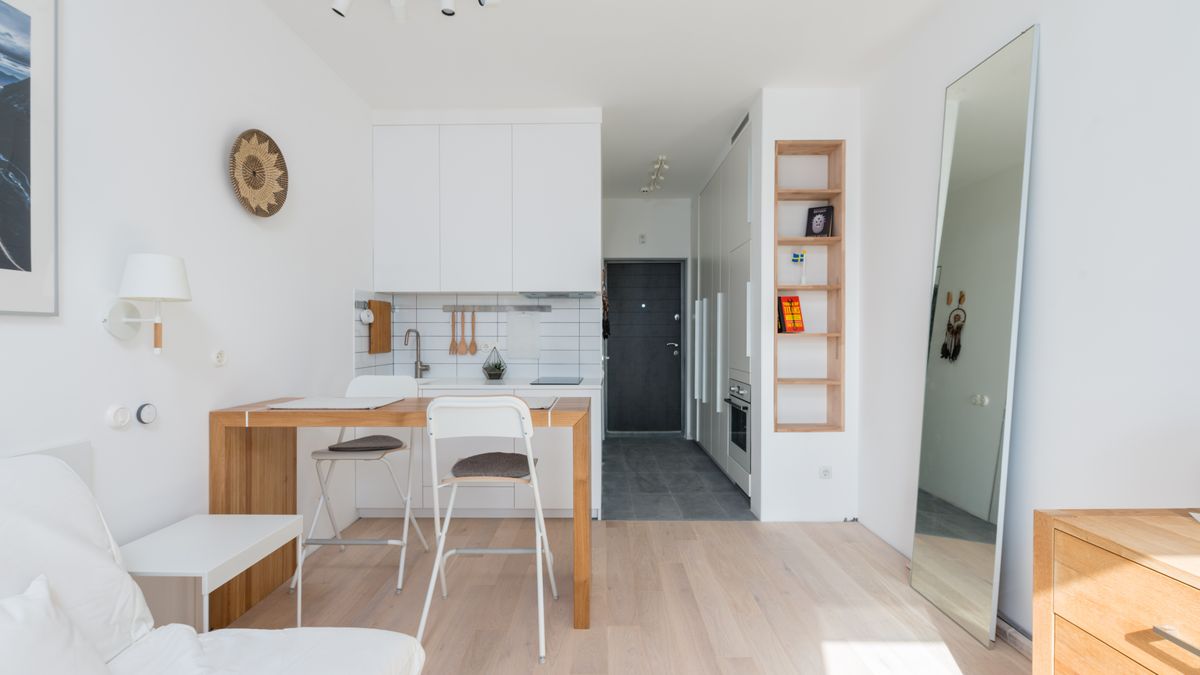
Most homes have one: the awkward corner between the chimney breast and the window, the dead space at the end of a landing, the nook behind the living room door. It is too narrow for a sofa, too dim for a reading chair, so it collects bags and unopened post. With a little planning, that same corner can become the calmest place in the house to work — and the easiest to walk away from at six o'clock.
The trick is not to squeeze an office into a corner, but to define a workspace that happens to live there. Three things do most of the work: a desk shallow enough to leave the room feeling open, light placed where it actually helps your eyes, and something that closes the workspace off at the end of the day.
Not every corner is a candidate. Before you measure anything, spend a day noticing how the space behaves.
Depth matters far more than width. A desk 40–45cm deep takes a laptop, a notebook and a mug quite happily while leaving a walkway behind you. Anything 60cm or deeper starts to feel like furniture you have to negotiate with.
In a tight corner, look at a wall-mounted desk on two folding brackets. It floats, it is easy to sweep under, and it makes a small room feel larger. Slim console tables and narrow dressing tables also work well and cost far less than purpose-built office furniture.
Ask what you genuinely need within reach: usually a laptop, a lamp, a drink, a pen and somewhere for a phone. Everything else — printer, files, spare cables — belongs on a shelf or in a box on top of the wardrobe. Paint the desk to match the wall behind it; a pale desk against a pale wall almost disappears. If you need storage, go upwards with a single shelf 30–35cm above the surface.
Overhead lighting is for the room. Your corner needs its own light, positioned so it falls on your work rather than into your eyes.
An adjustable task lamp to one side — the opposite side to your writing hand, so you do not cast a shadow over the page — is the best upgrade you can make. Look for an adjustable bulb: around 4000K for focused daytime work, nearer 2700K in the evening so the corner does not glare at midnight.
Aim the lamp at the desk, not the wall in front of you, and check for reflection on the screen by sitting down and tilting until the glare disappears. If your corner has no natural light, add a softer second source — a small floor lamp or a warm bulb on the shelf — so the space is lit rather than spotlit.
This is the part most people skip, and it makes the biggest difference to how calm the room feels in the evening.
Whichever you choose, closing the workspace should take under ten seconds. If it takes longer, you will not do it.
Calm comes as much from routine as from furniture. Set a small, repeatable sequence for the end of the day.
Clear the surface. Put the laptop away, or at least close the lid and slide it into a drawer. Wipe the desk, plump the cushion, switch the lamp to its warmest setting or off, and draw the curtain or unfold the screen. Two minutes, every day.
Then add one thing that is purely for you: a small vase, a candle, a plant that tolerates low light. When the desk is clear and the screen is closed, that is what you see instead of a pile of unfinished tasks.

Hi, my name is Anthony kuber. I am artist and fashion designer.
I love to travel and writing blogging.
Your email address will not be published. Required fields are marked *
Software Developer & Writer
Hey, I'm Diva, a developer and writer blending code and creativity. I'm driven by a deep curiosity and a relentless pursuit of excellence. Join me as I craft digital solutions and captivating stories.


